


A look back…
- Wall Street got coal in its stocking for Christmas, as the S&P 500 fell 2.4% and the Russell 2000 fell 8.3% in December. High quality fixed income also struggled, with the Bloomberg Aggregate off 1.6% last month.
- The big headwind for markets last month was a hawkish Fed. While the Fed cut rates by a quarter point at its December meeting, it penciled in just two rate cuts for 2025 (down from an original projection of four). Investors — particularly U.S. fixed income and U.S. small cap stock investors — seem increasingly worried about inflation.
- That said, it was a great year for U.S. stocks, with the S&P up 25%, the Russell 2000 up 11%, and the Nasdaq up 29%. The story of 2024 was one of “U.S. exceptionalism,” as our markets outdistanced those of most other countries.
A look ahead…
- A new year brings new — or maybe the same — questions for Wall Street: Will the Fed pull off a soft landing? What are the economic and market implications of a second Trump Administration? Will ex-U.S. stocks finally shine? Will the world prove a more peaceful place? Is the inflation genie back in the bottle? Can U.S. stocks continue to rally?
- The Fed meets January 28th and 29th and Wall Street expects the Fed Funds Rate to stay put at 4.25% to 4.5%. We think investors can deal with a slower, more modest series of rate cuts; rate hikes would be a whole different story.
- The MSCI China Index was up 20% in 2024, its first positive year since 2020. Investors will be watching China closely for signs its economy is pulling out of its deflation-driven funk and its nascent stock market rally has legs.
A look at a datapoint worth discussing…
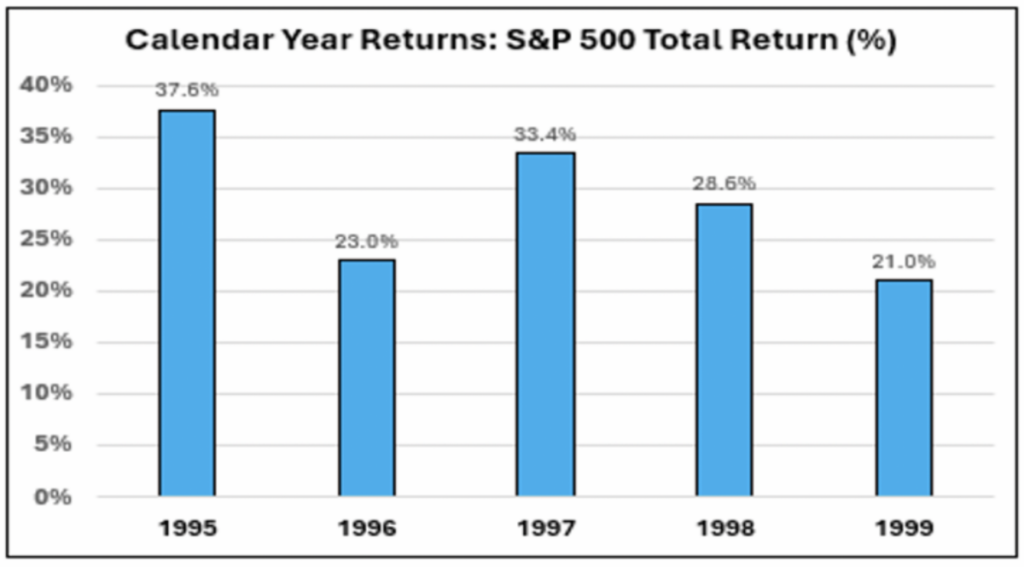
- Of all the questions noted above, the one we have gotten the most often of late is, “Can the bull market in U.S. equities continue?” — especially as the S&P 500 just registered back-to-back 20%+ years for the first time in 25 years.
- Our answer is yes, as share prices tend to track earnings, and for now Wall Street expects S&P 500 profits to grow by about 15% this year. Stepping back, we see parallels between today’s market and that of the 1990s, as 25+ years ago, the Fed was cutting rates, the economy was coming in for a soft landing and Wall Street was increasingly fixated on the transformative power of the Internet, akin to today’s interest in AI (artificial intelligence).
This Month’s Dataset

